
Just a few years ago, developing a custom CRM or ERP system, a company intranet, a B2B online store or another business management system seemed too expensive for many small and medium-sized companies.
It needed a team of programmers, a project manager, a designer, a tester and months of development. Budgets for complex company systems could reach hundreds of thousands of euros, and implementation could take many months or even years.
Artificial intelligence is changing this: in business system development, AI mainly speeds up the programming part.
AI programming tools make it possible to build data structures, admin panels, user roles, forms, reports, API integrations, tests and much of the other functionality faster — work on which a programmer used to spend many hours.
But there is one very important caveat.
AI can write code. On its own, it does not know how your company should work.
To build a good business system, you still need to know how the specific business process works, what data needs to be stored and how it is connected, what the user roles and access rights should be, how users will move through the system, how the system should integrate with other systems and how to ensure security.
This is exactly where there is a huge difference between “AI generated a program” and a professionally developed business system.
What can a company build with the help of AI today?
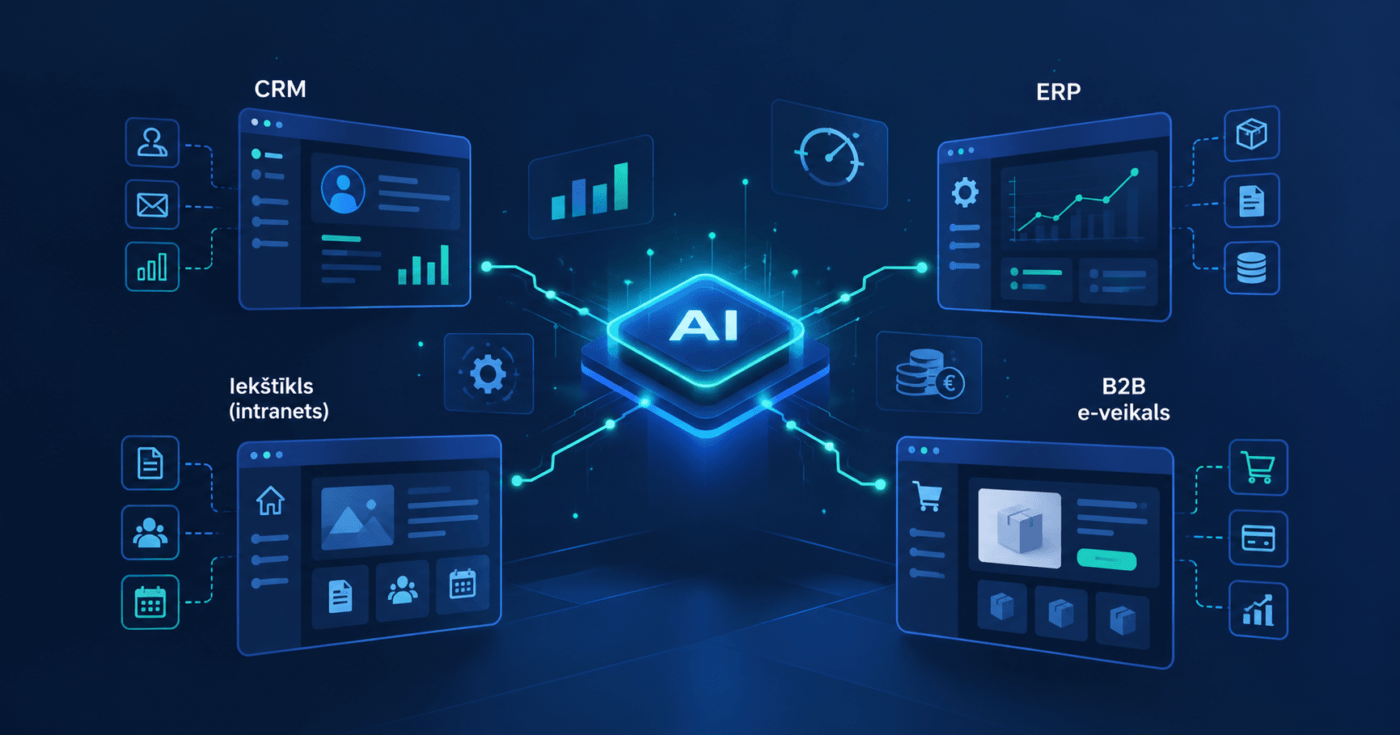
With AI-assisted development, it is possible to build a custom CRM and ERP system, a company intranet, time and work tracking, customer portals, warehouse management and B2B online stores considerably faster. AI speeds up programming, but a quality result still requires an understanding of business processes, system architecture, UX/UI, security and professional testing.
Does AI in business system development really make programming faster?
Yes, but there is no single universal percentage that can be applied to every project.
Research results differ considerably depending on the task, the programmer’s experience, the existing system and the AI tools used. In some controlled programming tasks significant time savings have been measured, while in complex, existing systems the gain can be much smaller.
That is why AI should not be seen as a magic “build a system” button.
The biggest gain from AI in business system development comes when an experienced specialist already knows what needs to be built and uses AI as a very fast development tool.
This changes the economics of a project. Work that used to require a large number of programming hours can now be done considerably faster in certain projects. That is why custom business solutions are becoming accessible to companies that previously could not afford their own CRM, ERP or internal system.
Can anyone now build their own business system with AI?
They can — especially if the person knows the specific business area well, can define requirements precisely and is prepared to spend a lot of time on development and testing.
AI can help create a database, an admin panel, forms, user authorisation, reports and integrations.
But you have to allow for the time.
AI generates code quickly, but you will still have to work out the requirements, review the generated code, test scenarios, fix errors, deal with security issues, think about the data model, set up backups and anticipate situations you did not think of at the start.
The larger the system, the more time goes not on writing code but on thinking about how the system should work correctly.
Why is programming knowledge with AI not enough on its own?
Let’s imagine a simple task: “Build me a CRM system.”
AI can generate a customer table, contact persons, deals, statuses and an admin panel.
But what happens next?
Can one customer have several contact persons? Does one customer have several projects? Does each project have its own person responsible? May a salesperson see financial information? What happens if an employee leaves the company? How are contracts stored? How does a lead become a proposal? How does a proposal become a project? How does a project become an invoice? How are project hours recorded? How does a manager see a project’s cost and profitability? How is it recorded which user changed what?
These are no longer just programming questions.
This is business logic, UX, data architecture and system design.
AI can help implement it, but someone first has to know what to implement.
Building a website with AI is easy today. But what happens next?
AI can currently generate a visually good website very quickly.
But a company usually needs more than a nice-looking HTML page.
It needs a content management solution, the ability to change texts and images yourself, SEO fields, forms and enquiries, email sending, analytics, cookie management, multilingual content, user rights, security updates, backups, speed, structured data and integrations with other systems.
So the question is no longer just “can AI handle website development?”
It can.
The more important question is: “Will the website be a properly manageable business tool a year from now?”
AI can also program an online store. But e-commerce is more than a product catalogue
Technically, building a product list, a basket and checkout is no longer particularly difficult.
The complexity starts with business processes.
What prices does a B2C buyer see? What prices does a B2B customer see? Does each company have its own price group? Are prices visible only after registration and administrator approval? How does VAT work? How is delivery calculated? How is warehouse stock reserved? How do coupons and the loyalty programme work? How are gift cards used? How are promotional banners and featured products managed? How are goods received in the warehouse? How is stocktaking done? How does the online store communicate with accounting, the warehouse or the ERP?
And, very importantly — how do buyers actually use a B2B and B2C online store?
This is where UX/UI knowledge and an understanding of user habits are needed.
A good online store is not the one with the most features. A good online store is one where it is easy for the customer to find, understand and buy the product they need, and easy for the company’s staff to process the order.
How does AI help build a CRM system?
Depending on the company’s needs, a custom CRM system can include:
- leads;
- a customer database;
- several contact persons per customer;
- sales stages;
- tasks and reminders;
- communication history;
- proposals;
- projects;
- contracts;
- invoices;
- documents;
- customer notes;
- staff responsibilities;
- sales reports;
- automated emails;
- receiving enquiries from website forms;
- integrations with the company’s other systems.
Most importantly — a CRM does not have to be a huge system with hundreds of features.
For many companies, a simple CRM that precisely matches their work process is far more valuable.
How does AI help build an ERP system?
An ERP can bring several company processes together in one system.
Depending on the company, it can include:
- customers;
- suppliers;
- products;
- the warehouse;
- purchasing;
- sales;
- orders;
- project management;
- employees;
- time tracking;
- costs;
- documents;
- contracts;
- invoices;
- reports;
- user roles and rights;
- integrations with external systems.
You do not have to build “the whole ERP” on day one.
A modern approach is to start with the processes that bring the company the greatest benefit and then extend the system with modules.
What can a company intranet include?
An intranet is the company’s private digital environment for employees.
It can include:
- company news;
- announcements;
- events;
- a document library;
- procedures and instructions;
- an employee directory;
- internal contacts;
- storage for files and PDF documents;
- holiday requests;
- facilities requests;
- IT support requests;
- HR forms;
- training materials;
- surveys;
- management announcements;
- access rights for departments and roles;
- email digests;
- an environment adapted for mobile devices.
The result — company information is no longer scattered across emails, folders and chats.
How does a time and work tracking system work?
A system like this can be very simple or become a full project management tool for the company.
It can include:
- customers;
- projects;
- tasks;
- employees;
- hours worked;
- hourly rates;
- planned hours;
- actual hours;
- the project budget;
- staff costs;
- the project’s cost;
- profitability;
- approval;
- monthly reports;
- exports for accounting;
- preparing billable hours.
A manager can see not just “how many hours we worked” but also how much the project actually cost the company and whether it made money.
A B2B online store with warehouse and ERP functions
A B2B online store can be not just a sales channel but also part of the company’s order and warehouse management system.
The customer side
- B2C and B2B customers;
- company registration;
- administrator approval;
- individual prices;
- customer price groups;
- volume discounts;
- promotions;
- coupons;
- a loyalty programme;
- gift cards;
- featured products;
- a banner management system;
- order history;
- repeat orders;
- several users per company.
Products and warehouse
- a product catalogue;
- categories;
- variations;
- stock levels;
- receiving goods in the warehouse;
- warehouse movements;
- reserved stock;
- suppliers;
- purchase prices;
- selling prices;
- stocktaking.
Administration
- customers;
- orders;
- the warehouse;
- price groups;
- discounts;
- coupons;
- gift cards;
- banners;
- featured products;
- reports;
- user roles;
- an action audit log.
If needed, payment and delivery integrations can be added to the solution, as well as connections to the company’s other systems.
As a result, the company gets not just an online store but a sales and order management system.
How much does custom business system development cost?
This is where one of the most significant changes has taken place.
AI in business system development does not by itself remove the need for business analysis, architecture, UX/UI, integrations, testing, data migration and security. But the programming part can be speeded up significantly.
In CREATING.LV’s AI-assisted development model, custom systems can become accessible to small and medium-sized companies too.
| Solution | Indicative, from |
|---|---|
| A small company’s internal system | 5,000 EUR |
| Time and work tracking system | 5,000 EUR |
| Custom CRM system | 5,000–10,000 EUR |
| Small / modular ERP system | 5,000–10,000 EUR |
| B2B online store + warehouse / basic ERP functions | 10,000 EUR |
The price is indicative and depends on the functionality, integrations, data migration, user roles and the complexity of the business processes. After assessing the requirements, we prepare an individual proposal.
The aim is not to promise, for 10,000 EUR, a system that in a traditional company would cost half a million.
The aim is not to overpay for features the company does not need, and to use AI, ready-made technology components and CREATING.LV’s experience to implement the business logic you need more efficiently.
How quickly can a system be developed with AI?
A system does not always have to be programmed for six months.
If the company’s needs match modules and technical solutions that can be reused and adapted, you do not have to start with a completely empty project.
A ready technical foundation can be used and customers, projects, documents, proposals, invoices, users, rights, time tracking, the warehouse, products, B2B pricing logic and other modules adapted to the specific company’s needs.
This can be considerably faster than programming everything from scratch.
However, a specific development timeline can only be set after the requirements have been assessed.
Is AI-generated code secure?
Security is not ensured by whether the code was written by AI or a person. Security has to be designed.
A professional business system needs secure authentication, user roles and access rights, server-side managed sessions, protection of sensitive data, an action audit log, input validation, access restrictions, backups and regular system maintenance.
AI-generated code also has to be reviewed and tested.
Why doesn’t AI replace UX/UI, architecture and business analysis?
In the past, a large part of a project budget went on a programmer manually writing a large amount of fairly predictable code.
Now AI can speed up this part of the work.
But the most valuable knowledge has not disappeared. It has become even more important.
You need to know:
- what to build;
- why to build it;
- how it should work;
- how people will use it;
- how the data will be connected;
- how the system will develop in the future;
- what must not be built wrongly from the very start.
AI can help implement a good idea faster. It can also help implement a bad architecture faster.
That is why experience is still essential.
Why CREATING.LV’s advantage is not just AI
Almost anyone can work with artificial intelligence today.
CREATING.LV’s advantage is experience in web development, e-commerce, digital projects, integrations, UX/UI and system design.
We were also programming at a time when AI could not write code for us.
That is why today we use AI not to replace knowledge, but to put the knowledge of experienced people into practice faster and more efficiently.
This lets us offer custom business software for a much more reasonable budget than when practically all code had to be written by hand.
How to start developing a system for your company
Start not with technology but with the problem.
Describe a process that currently takes up too much staff time, happens in Excel files, emails or several unconnected systems.
For example:
- how a new customer is taken on;
- how a proposal is prepared;
- how an order is approved;
- how goods are recorded;
- how staff hours are recorded;
- how an invoice is prepared;
- how a manager receives a report.
From this process, system requirements can be drawn up and it can be decided what is worth automating first.
Is there still a process in your company that is run in Excel?
If customers, orders, the warehouse, staff hours, documents or other company processes are still managed in Excel files, emails or several unconnected systems, a custom system may no longer be as expensive as you think.
Tell us how the process currently works. CREATING.LV will help you understand what is worth automating, what the system architecture should be and what the development budget might be.
Can you build a CRM or ERP system yourself with AI?
Yes, especially if you know your business process well and have technical knowledge. AI can help generate the database structure, code, forms, reports and integrations. But you will have to define the business logic, architecture and user rights yourself, test the system and ensure its security and maintenance.
How much does custom CRM development cost?
For a simpler custom business system, the starting budget in a CREATING.LV proposal can be from around 5,000 EUR. A CRM with broader functionality, integrations or automation can cost 5,000–10,000 EUR or more. The exact price depends on the modules needed and the business processes.
How much does ERP system development cost?
ERP is not one specific product — one company needs a warehouse and orders, another needs projects, purchasing, time tracking, finance or integrations. A small modular ERP-type solution can start with the most important processes and be extended later. The indicative starting budget for a simpler modular solution is around 5,000–10,000 EUR, while the cost of a complex ERP system can be considerably higher.
How much does a B2B online store with individual prices cost?
The CREATING.LV indicative starting budget for a B2B online store with customer registration, individual prices and basic warehouse or ERP functionality is around 10,000 EUR. Additional integrations, complex pricing logic, data migration or other modules may increase the price.
What does a company intranet include?
An intranet can include company news, documents, procedures, an employee directory, announcements, events, request forms, holidays, IT requests, training, a file library, department access rights and other tools for internal communication and organising work.
How quickly can a business system be developed with AI?
AI can significantly reduce the time needed for programming, but it is not correct to promise one universal speed-up for all projects. For simpler, well-defined tasks the gain can be very large, while in complex systems analysis, UX/UI, architecture, integrations, testing and data migration still take a lot of time. If ready-made technical modules can be used, development can be even faster.
Is a system developed with AI secure?
Security is not ensured by whether the code was written by AI or a person. It has to be designed. A professional system needs secure authentication, user roles and rights, server-side managed sessions, protection of sensitive data, an audit of actions, backups, input validation, access restrictions and regular system maintenance. AI-generated code also has to be reviewed and tested.