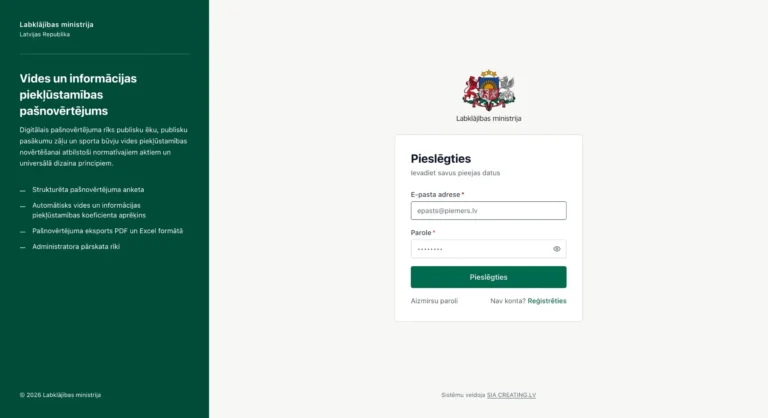
In short: when developing a system for a public institution, the main work is not programming but clarifying the requirements: the technical specification becomes the basis of the contract, user roles have to be separated from the start, and the handover needs documentation that the institution can also use without the developer. Below — what we learned developing an environment and information accessibility self-assessment tool for the Ministry of Welfare.
The task: from an Excel questionnaire to a single workspace
The Ministry of Welfare project was based on a self-assessment questionnaire in Excel format. Institutions use it to assess the accessibility of public buildings, event halls and sports facilities. Instead of separate files, one online environment was needed, with a shared question structure, a clear order for filling it in and the ability to collate the data. The technical specification planned a scale of approximately 2,000 sites. The project was handed over in 2026.
A more detailed project description with screenshots is in our portfolio.
What we learned
1. The specification is a contract — read it as a contract
In the public sector, the technical specification is not a recommendation but a binding document. It is worth clarifying every unclear wording right at the start, in writing. Later on, “we meant something else” is no longer an argument for either party.
At the same time, not everything can be foreseen in advance. Testing showed that respondents often need to explain their answer, so we added a comment field to every single question. This was not originally provided for in the specification, and we developed it at no extra charge — the system had to work for real users, not just comply with the document.
2. Roles have to be separated from day one
The system has two very different activities: the respondent enters information about their site, while the administrator reviews submissions, selects data and manages the questionnaire itself. If roles and permissions are only planned at the end, the system turns into a collection of patches. That is why we built the data model and the roles at the same time.
3. The questionnaire has to be editable without a programmer
The methodology changes over time. That is why the administrator can manage the questionnaire structure themselves, rather than commissioning development for every change. This takes more work at the start, but in the long term it saves both the institution’s budget and time.
4. A large scale changes the priorities
If there are thousands of sites, data selection, filters and export become more important than visual effects. The administrator needs to be able to find a specific site quickly and compare results, not browse submissions one at a time.
5. Handover is a separate stage of work
The institution has to be able to use and maintain the system even if people change. That is why we included a user guide, an administrator guide, the source code and training in the handover package.
Who this experience is useful for
The same principles apply to any system that replaces Excel spreadsheets: municipal registers, internal questionnaires, application processing or company processes. If you have a similar task, see the systems development service or describe your situation.